NeurIPS2026
Who wrote the accepted papers, and who works on what. Two ways in:
Find your institution
Rank, paper count and research-area mix for every university, lab and company at NeurIPS 2026.
e.g. POSTECH · KAIST · Google · Tsinghua · MIT Search institutions →Search by topic or paper
Type a topic or paste your abstract. See which universities and companies published the most papers like it.
e.g. retrieval-augmented generation · protein design · your abstract Search topics →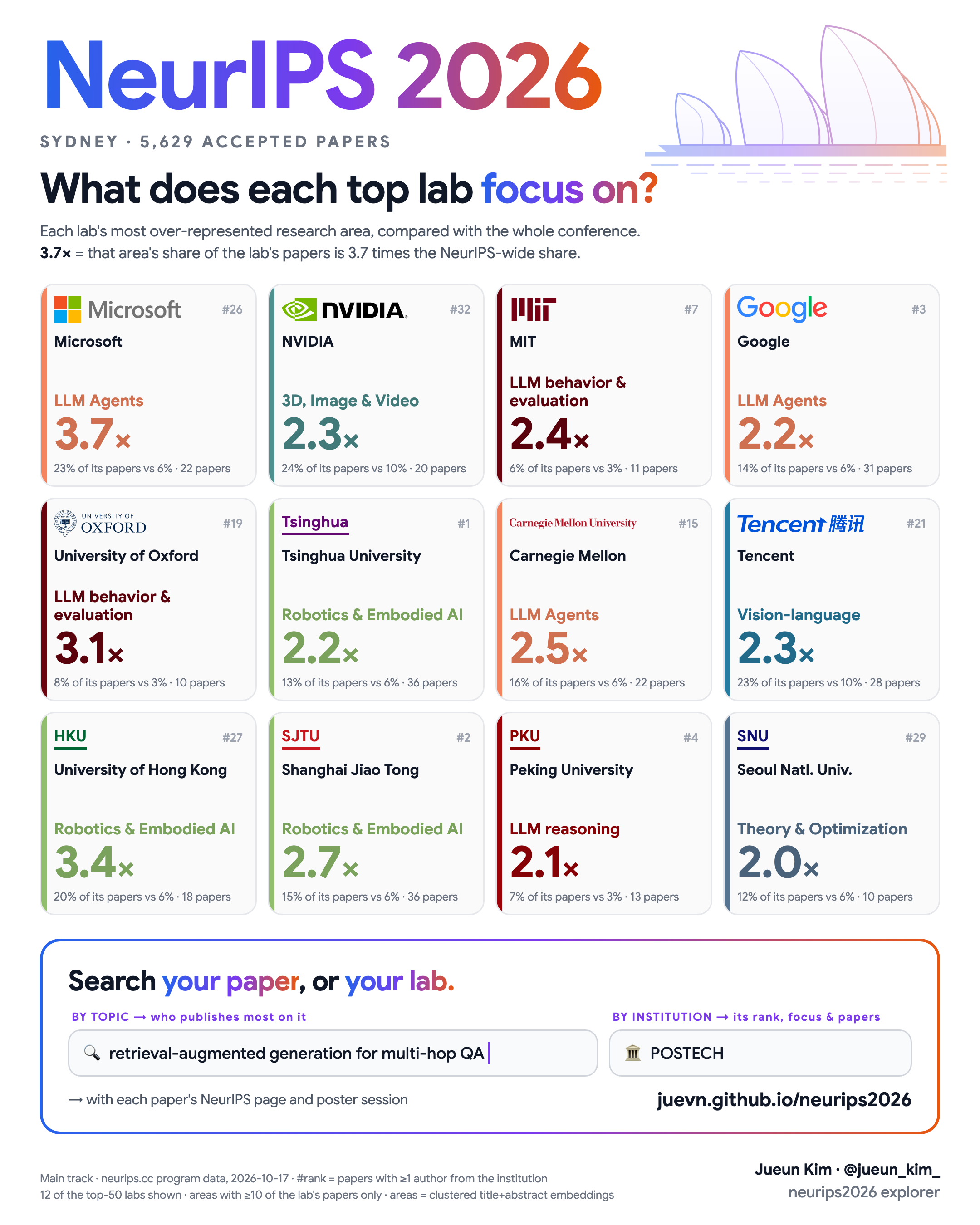
Made by Jueun Kim (POSTECH) · @jueun_kim_
My NeurIPS 2026 paper: Hi-Q, hierarchical query refinement for multi-hop QA · Sydney Poster Session 6, Dec 10
Find your institution
Accepted main-track papers by institution, and what each institution publishes.
Try ····
All institutions
| # | Institution | Papers | Share | Research-area mix |
|---|
Who publishes on your topic?
Type a topic or paste a title and abstract. We find the NeurIPS 2026 papers closest in meaning, then count which institutions wrote them.
Try
Or try a whole paper:
Look at the
closest papers
How this was made
data, method and caveats
- Papers and institutions come from the official neurips.cc program data, which lists each author's institution from their OpenReview profile. Main track only, snapshot .
- Counting: a paper counts once for every institution with at least one author on it, so shares add up to more than 100%. The fractional count splits each paper equally across its authors, then across each author's institutions.
- Names are normalized with a hand-checked table of about 380 institutions plus rules for typos, sub-units and acronyms. Google includes DeepMind, Meta includes FAIR, all Chinese Academy of Sciences institutes are merged, HKUST and HKUST (Guangzhou) are separate. Less common names may still appear under more than one spelling.
- Research areas are not official tags. Titles and abstracts were embedded with bge-small-en-v1.5 and clustered, then the clusters were named from their top terms. Borders between neighbouring areas are fuzzy.
- Topic search runs entirely in your browser: your text is embedded with the same model (downloaded once, about 33 MB) and compared with every paper. Nothing you type is sent anywhere.
- Industry vs academia: companies and corporate labs are industry. Universities and public or non-profit institutes such as CAS, Max Planck, RIKEN, Shanghai AI Lab and Mila are academia.
- No author names are included. Download the institution table (CSV).
- Spotted a wrong mapping? Corrections are welcome.